Catalyst · August 23, 2026
The Permission That Never Comes
My father died with the tags still on. I inherited the drawer, and almost the habit.
We were clearing out my father's closet six days after the funeral when my cousin, Paa Kwesi, found the shoes.
They were still in the box. Tissue paper folded over the tongues like a shroud, the way the shop does it. Good shoes. The kind a man buys when he has decided he is finally worth them. The receipt was in the box too. He read the date out loud, and it went quiet in that room, because the date was eleven years old.
"He never wore these," he said.
We kept finding them after that. A watch, sealed. A leather jacket with the tag looped through the collar. A fountain pen in its velvet, the nib never wet. A bottle of something old and expensive, the wax seal unbroken, a card taped to it in his handwriting that said only for a good occasion. He had been waiting for the good occasion. He had waited straight through to the end of the occasions.
I sat on the edge of his bed holding the pen, and I understood something I did not want to understand.
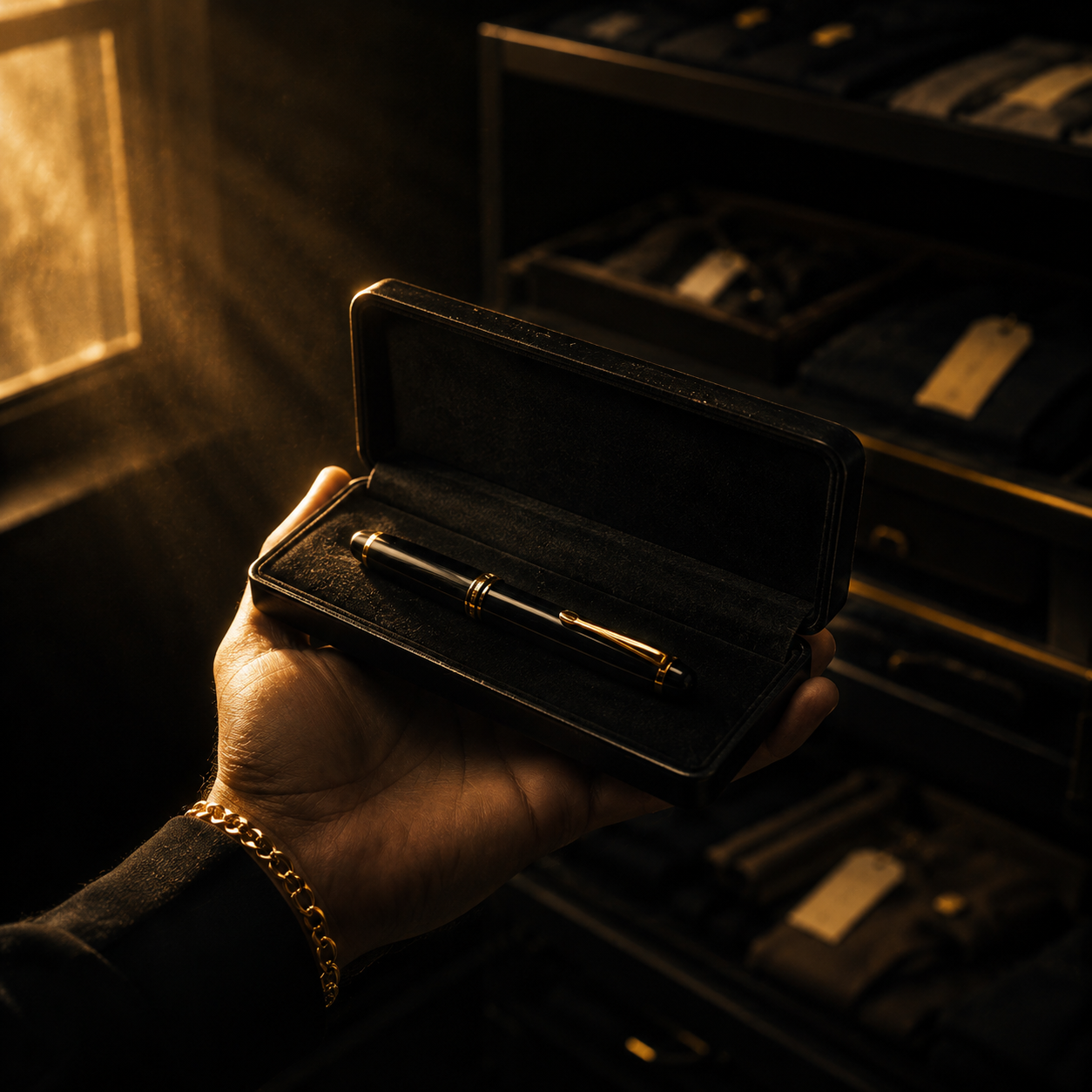
He was not a hoarder. He was a saver. There is a difference, and the difference is the whole story. A hoarder cannot let go of the past. A saver cannot arrive at the present. He believed, the way careful men believe, that the good things were for later. That a day would come, announced somehow, cleaner and worthier than the ordinary Tuesdays he was actually living, and on that day he would break the seals and put on the shoes and pour the drink and finally begin to enjoy the life he had so quietly prepared for.
Nobody ever announced the day. Nobody ever will. That is the part he did not know, and the part I am only now learning: the day of permission is not coming, because there is no office that issues it.
I drove home that night with the pen in my coat pocket. And somewhere on the highway I remembered my own drawer.
The folder called Ithiel
I keep a folder on my laptop. I named it Ithiel, on purpose. It is a Hebrew name and it means God is with me. I gave it that name because I believed, quietly, with a shake in the hands I told no one about, that I had been handed words I was meant to say out loud.
Inside: half-finished essays. Research gathered the way a squirrel gathers what it will never eat. A logo. A cover image. A document titled, without a shred of irony, social media growth strategy. Everything a person would need to begin. Nothing that had begun.
It was my father's closet in software. Same drawer. Same shroud of tissue paper. Same seal, unbroken, waiting for the good occasion. I had inherited the habit before I ever knew it was a habit, and I would have carried it clean to my own last Tuesday if he had not, by dying, opened his closet in front of me.
You have a folder too. You may not call it Ithiel. But you know the file you keep almost-opening, the seal you keep not breaking. Hold it. Keep it in your hand while we walk.
The hallway where the bells stopped
Here is what nobody warns you about.
You spend the first two decades of a life inside a machine of permission. A bell tells you when to move. A teacher tells you when you have earned the next room. A form gets stamped, and you advance. Someone with authority looks at you and says yes, go. You learn, though no one says it aloud, that beginning is a thing granted to you by someone above you.
Then the bells stop. And nobody announces that they have stopped.
So you keep standing in the hallway. Waiting for a door to open. The hallway is empty. The door was never locked. The person holding the key is you, and the memo got lost.
My father stood in that hallway for eleven years with a good pair of shoes in a box. I wrapped my own standing in respectable names. Doing my research. Gaining experience. Waiting for the right season. I used to think his little habit was a sad, harmless thing. Then I found my own version and understood it was neither sad nor harmless. It was a life, folded in tissue paper, saved past the point of use.
We suffer more often in imagination than in reality.
What the old ones already knew
The Stoics saw this and named it without flinching.
Epictetus was born a slave. He knew in his body how much of a life sits outside your hands, because nearly all of his once did. And the spine of everything he taught was one clean cut. Some things are up to you. Some are not. Whether you begin is up to you. Whether the world claps afterward was never your department.
Marcus Aurelius wrote himself private notes on the Danube frontier, on campaign. He was the most powerful man alive. He could have had anything stamped by anyone. And still he had to remind himself, in ink no one was meant to read, that the beginning must come from inside his own skull. If the emperor of Rome had to grant himself permission, yours is not in the mail either.
The scriptures turn it to stone. A line from the Psalms, lifted again in the Gospels: the stone the builders rejected became the cornerstone. Read it slowly. The thing waved off as not-yet-worthy turns out to be the rock the whole house stands on. It was load-bearing the entire time. It was only waiting to be picked up.
And then the harder story, the one I could not shake. A man is handed a sum and told to use it. He is so afraid of losing it, so certain he has no right to risk it, that he digs a hole and buries it and hands it back untouched. He kept it safe. He kept it wrapped. And he is the one the parable condemns. Not for failing. For refusing to begin.
I read that and felt it land under the ribs. My father buried his talent in a shoebox. I buried mine in a folder. The parable does not soften for either of us.
The stone that the builders rejected has become the cornerstone.
The alarm I mistook for wisdom
Turn on the light and watch what the body actually does while it waits.
When you feel unready, an old alarm fires in the brain. Ancient wiring, built to spot a predator in tall grass, and it cannot tell a predator from a blank page. To that alarm, beginning looks like stepping into the open. Stepping into the open looks like danger. Danger triggers a freeze.
And from the inside, the freeze feels exactly like wisdom. It feels like patience. It feels like good judgment, like waiting for the right time. It is a smoke detector that cannot tell a house fire from burnt toast, and my father let his run for eleven years and called the screaming prudence.
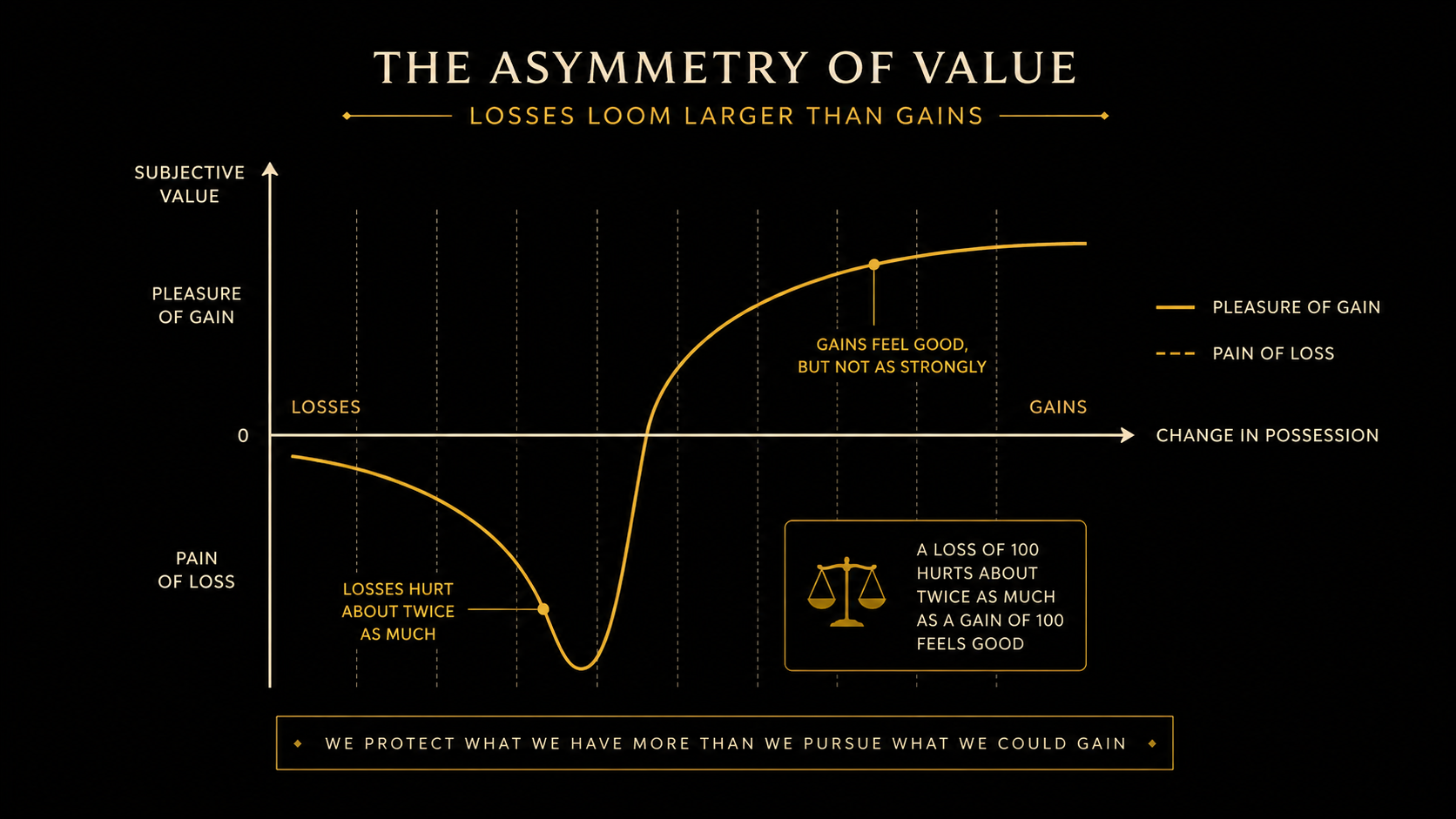
Decision researchers have a name for the feeling underneath. Losses loom larger than equivalent gains. This is why the sealed shoes sat in such a beautiful, protected state. They could not disappoint yet. They had no scuffs. The moment he put them on, he would expose them to the world, to rain and gravel and the ordinary insult of use. His nervous system did the arithmetic and shrieked that the pain outweighed the gain.
So they stayed in the box. Perfect. Unworn. Safe. Never once his.
Here is what I could not see from inside my own version. There is a real idea in decision theory, the value of waiting: sometimes it is genuinely wise to hold off on a move you cannot undo until better information arrives. My mind knew this was true, which is precisely why it stole the costume. It told me I was gathering information. I was only afraid.
And waiting is never free. Traders have a word for the daily bleed on an option no one has yet exercised. They call it theta, the slow leak of worth as it drifts toward expiry. Your life is a wasting asset. Those eleven years were theta, paid in the one currency that never refunds. The shoes did not rot in the box. My father did, a little, every year he did not wear them.
The model I had to let out of the lab
One more picture, from my own trade, because it is what finally showed me this in cold, clear light.
When you train a machine to learn, there is a moment every engineer meets. The model scores perfectly on the data it was trained on. It has never met a case it could not handle, because it has never met a case it was not shown. Engineers call this overfitting: the model fits its training examples far more closely than it fits anything new, because it has memorized the drawer instead of learning what makes its contents alike.
And it is useless. A model that has only ever seen its own training set has learned nothing about the world. Its flawless score is a lie, because it has never once touched reality. The only way to know whether it learned anything real is to release it onto data it has never seen. To let it be wrong in the open. To expose it to loss.
The unbegun life is an overfit model. Flawless in the box. Untested against a single real day. Worthless until it is let out. There is no learning without the risk of being wrong. My father polished a model he never deployed and called it caution. I nearly did the same, and I have his tools and his hands, so I would have done it well.

The beginners were never chosen
Hunt through history for the moment of permission, and you will almost never find it there.
Nobody licensed the Wright brothers. They ran a bicycle shop. The credentialed men with government money failed loudly and expensively while two mechanics who authorized themselves lifted a machine off the sand. Gutenberg was not ordained to reinvent human memory. He was a goldsmith in debt. No committee convened to grant a frightened planter the standing to lead a war he was likely to lose.
The pattern is relentless once you see it. The people who bent the shape of the world were not chosen and stamped and sent. They looked at the empty desk, understood no clerk was coming, and stamped their own form. History does not remember the ones who waited to feel ready. It does not remember them at all. That is rather the whole point of them.
My father was a good man history will not remember. Not because he lacked the shoes. Because he never put them on.
The one rope
Come down now, from the sky and the empire and the war camp, and hold one real thing.
When positive psychology stopped studying what breaks people and started studying what makes them come alive, it found something plain. What makes a life feel meaningful is not comfort, not safety, not the absence of risk. It is agency. The felt sense that you are the author of your own actions. Deci and Ryan made it one of three needs — alongside competence and relatedness — at the core of their theory of motivation. Autonomy is not a luxury of our species. It is a nutrient. Starve a person of the sense that they are the one deciding, and they wilt, even inside a closet full of good, unworn things.
So the waiting was never only costing my father the shoes. It was starving him of the very thing that makes a life feel like a life.
Here is the instrument. Not a mindset. An action, small enough that the fear stays asleep.
Take the thing you named at the start, the sealed one. Do not break the whole life open at once. The alarm will scream. Do the smallest version that cannot be undone. Wear the shoes on an ordinary Tuesday. Send one sentence. Write one paragraph. Open the bottle for no occasion but the fact that you are alive to open it. Small enough that the smoke detector stays quiet. Real enough that you cannot re-wrap it in the tissue paper.
You are not launching the ship. You are cutting one rope. But the instant a rope is cut, you are no longer a person on the dock pretending the tide will decide. You have begun. And beginning, it turns out, was the only permission there ever was.
He who has begun is half done. Dare to be wise.
I came home from my father's house and I opened one of the essays in the folder called Ithiel. I did not finish it. I did not even read all of it. I typed a single new sentence at the bottom, and I saved it under a new name, out of the drawer.
The next morning I used his fountain pen to write a grocery list. Milk, bread, coffee. Nothing worthy of it. The nib scratched, the ink bled a little into the cheap paper, and it was, at last, a pen and not a relic.
You are standing at an empty desk. The stamp is warm in your own hand. You have stood there so long you mistook the waiting for the will of God, or the market, or your father's caution, or the right time. There is no clerk. There was never a clerk. There is only you, the form, and a closet full of good things bleeding value while you save them for a day that does not come.
So lift the stamp. Bring it down. And listen: the sound it makes is not the sound of permission being granted.
It is the sound of the seal breaking on a life you were always allowed to live.
— Zyvahn
Follow ZYVAHN
Next: the difference between a saver and an arriver, and why one of them is already dead.
Receive Catalyst Weekly